
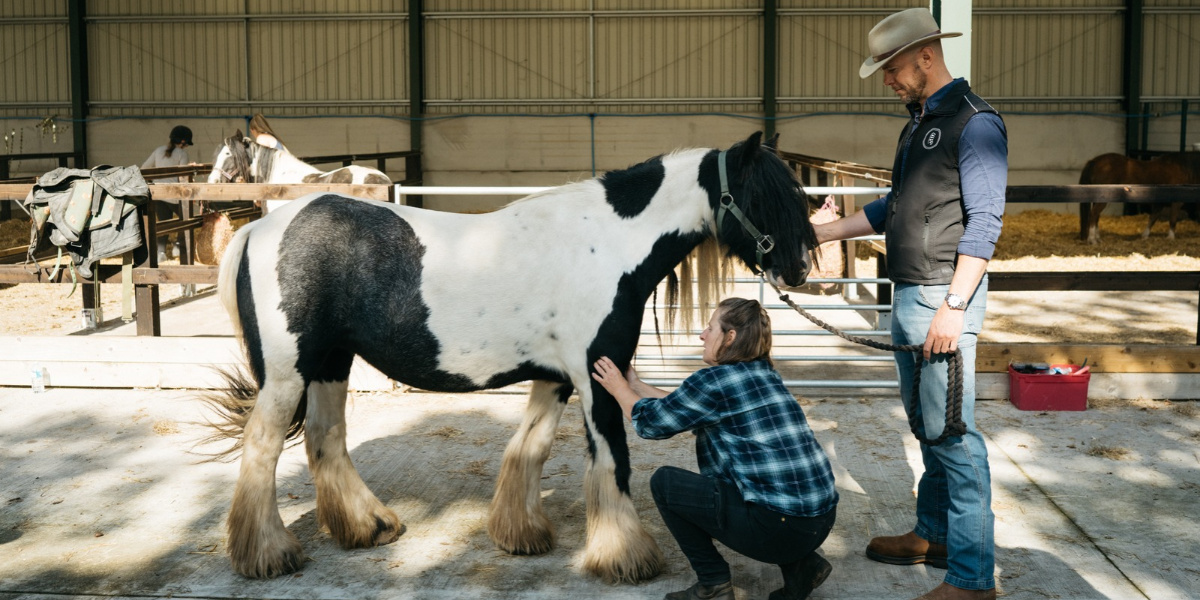
The owner has the video ready before the horse is out of the stable. An app on her phone has already measured the asymmetry in his trot and flagged a hind limb. It is useful information, and a good practitioner will look at it properly. Then they will do what the app cannot. They will walk up to an anxious young horse, read how he is holding himself, and decide where to put their hands first.
If you are searching for an AI-proof career that keeps you working with animals, that gap between the data and the horse is worth paying attention to. Artificial intelligence is moving into almost every profession, animal health included, and it is reasonable to ask which kinds of work will still need a skilled person in the room.
Animal osteopathy is one of the clearer answers. The technology will change how practitioners record, measure and communicate, but it is very unlikely to take over the work itself.
Why So Many People Are Looking for an AI-Proof Career
In 2017, economists Carl Benedikt Frey and Michael Osborne published one of the most widely quoted studies on automation. They estimated how susceptible 702 occupations in the United States were to computerisation, and their headline figure, that 47% of US employment was at high risk, has been repeated and argued over ever since. Generative AI has since put writing and office-based roles firmly in the frame as well.
The headline number matters less than the reasoning behind it. Frey and Osborne identified three "bottlenecks" that machines struggle to get past: perception and manipulation, particularly in messy and unpredictable physical environments; creative intelligence; and social intelligence, meaning the ability to negotiate, reassure and read other people.
Picture a working day in animal osteopathy and you will find all three, usually before lunch.
The Animal Patient Who Cannot Fill In a Form
Much of the AI in human healthcare depends on structured information: symptoms described by the patient, questionnaires and digital records that software can sort and compare. Animal patients offer none of that. A dog cannot tell you that the pain started after a bad landing at agility, and a horse cannot rate his discomfort out of ten. The history comes second-hand from an owner who may have missed the early signs.
What the animal does give you is a constant stream of information through the body. Muscle tone, posture, tail carriage, ear position and a shift of weight away from your hand all tell you something, provided you know how to read them.
Why the Way You Touch an Animal Matters
A study by Lansade and colleagues (2018) makes this point neatly. Two groups of horses were groomed over 11 sessions. One group received gentle grooming focused on the areas each horse seemed to enjoy most, while the other was groomed using a fixed, standard routine. By the final session, the gently groomed horses showed significantly more contact-seeking behaviour, and the standard group showed significantly more avoidance.
The task was the same in both groups. The difference was whether the person doing it responded to the animal in front of them. That responsiveness sits at the centre of osteopathic work with animals, where technique, pressure and pace are constantly adjusted to the tissue response and to what the animal will tolerate on that particular day.
Careers Working With Animals Happen in Unpredictable Places
Much of animal osteopathy happens on yards, in fields and in clients' kitchens. The footing changes, the light changes, and the horse who stood quietly last month may be on high alert because his field companion has just been led away. A dog may arrive wound up after a long car journey.
This is exactly the kind of unstructured physical environment that Frey and Osborne flagged as hard to automate. It is also where practitioner safety depends on reading body language early and adjusting your position before an animal has to tell you more forcefully.
Then there are the people. Much of the work involves explaining findings to owners, riders and trainers, agreeing a realistic plan and building trust over time.
Where AI Is Already Changing Animal Health
None of this means animal osteopaths can ignore technology, and some of the most promising AI tools in veterinary medicine target problems practitioners see every week.
Gait Analysis on a Smartphone
Lawin and colleagues (2023) tested a smartphone app that uses computer vision to measure the vertical movement of a horse's head and pelvis during trot, with no markers or sensors attached. They compared it against a multi-camera motion capture system in 25 horses at a university equine clinic in Sweden. The mean difference between the two systems' lameness measurements was below 2.2 mm, and the authors concluded that the app could detect lameness at clinically relevant levels.
Data Still Needs Hands and Judgement
A measurement of asymmetry tells you that a horse is moving unevenly. It does not tell you why. The cause could be orthopaedic pain, a compensation pattern from another region, a saddle problem, a hoof imbalance or something neurological, and diagnosing the cause is the veterinarian's role. Understanding where an animal osteopath's scope of practice begins and ends is what allows practitioners to use this kind of data well, recognising when a finding calls for veterinary referral and when it fits a musculoskeletal picture they can help with.
The practitioners who thrive will be the ones who can read an app report, weigh it against what their hands are telling them, and talk it through with the vet and owner.
Building an Animal Osteopathy Career That Lasts
Many people who come to LCAO are changing direction. Some have spent years in office jobs and want work that is physical and outdoors. Others are lifelong horse or dog owners who have seen what good manual therapy can do and want to understand it properly.
The skills that make an animal osteopathy career durable take time to build. Palpation develops over years of supervised practice. Clinical reasoning comes from seeing hundreds of animals and learning to form and revise a working hypothesis as you go. Professional relationships with vets, farriers, saddle fitters and physiotherapists are built one case at a time.
AI will still have a useful place in a practitioner's week. It can help with clinical notes, scheduling, client reminders and marketing, which for self-employed practitioners frees up more time for hands-on work. We have looked before at why osteopathy is considered an AI-proof profession in broader healthcare terms, and the same logic holds here, with the added complexity of a patient who cannot speak for themselves.
Formal recognition matters as well. LCAO's Gatehouse Awarded Level 6 Diploma in Animal Osteopathy is Ofqual-regulated and sits at bachelor's degree level on the UK's Regulated Qualifications Framework, so graduates can show their expertise has been independently assessed.
Work That Needs You There
The question behind most searches for a future-proof career is a simple one: will this work still need me in ten years? For animal osteopathy, the honest answer is yes, though the job will look a little different. Practitioners will carry more data into appointments and share more of it with vets and owners.
The horse on the yard will still need someone to walk up to him calmly, read what he is saying, and work with his body rather than against it.
References
Frey, C. B., & Osborne, M. A. (2017). The future of employment: How susceptible are jobs to computerisation? Technological Forecasting and Social Change, 114, 254–280.
Lansade, L., Nowak, R., Lainé, A.-L., Leterrier, C., Bonneau, C., Parias, C., & Bertin, A. (2018). Facial expression and oxytocin as possible markers of positive emotions in horses. Scientific Reports, 8, 14680.
Lawin, F. J., Byström, A., Roepstorff, C., Rhodin, M., Almlöf, M., Silva, M., Andersen, P. H., Kjellström, H., & Hernlund, E. (2023). Is markerless more or less? Comparing a smartphone computer vision method for equine lameness assessment to multi-camera motion capture. Animals, 13(3), 390.


