
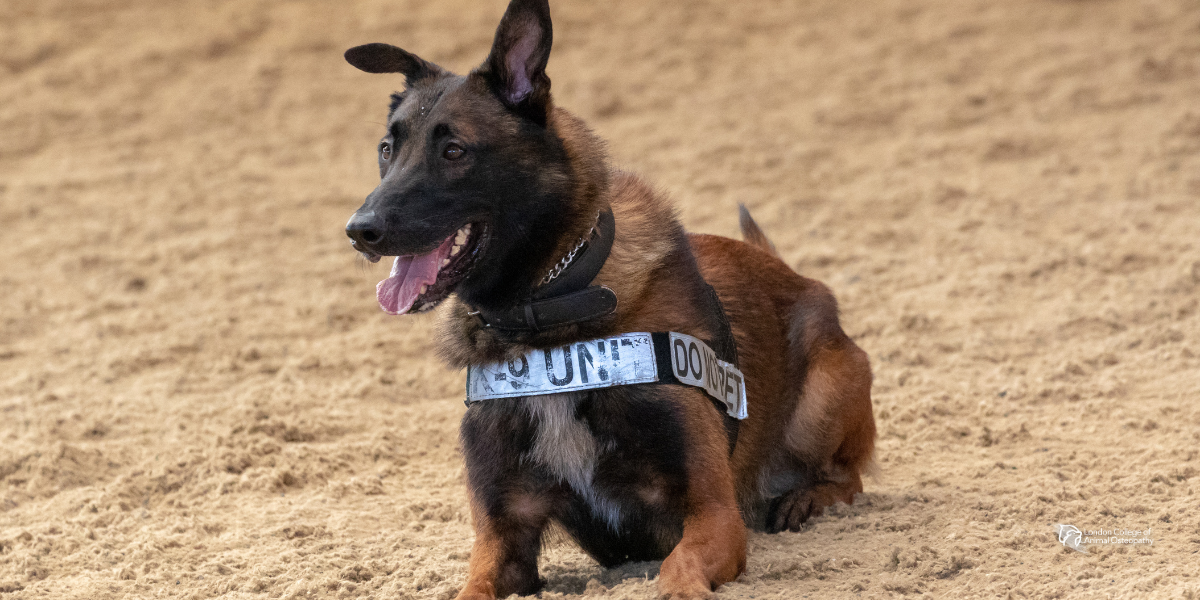
A search and rescue dog working a rubble pile is not the animal to tell you she is hurt. She will keep climbing and keep scenting, because that is what she was trained and bred to do. Most handlers only find out something is wrong after the search ends, when the dog who normally jumps straight into the vehicle hesitates, or takes the stairs at home more carefully than she did the week before. That gap, between what a working dog is willing to do and what her handler can actually see in the moment, is where a great deal of working dog injury quietly begins.
Osteopathy for police, military and search and rescue dogs sits at an odd intersection: a population with some of the highest physical demands of any dogs alive, and some of the least consistent access to hands-on musculoskeletal care. These dogs are asked to do things that no companion dog ever will: scale rubble at speed, absorb the shock of repeated apprehension work, track for hours over broken ground, or search a collapsed structure while carrying their own bodyweight up and down debris fields. Police dogs alone are commonly estimated at around 50,000 actively serving U.S. law enforcement agencies, a figure separate from the civilian search and rescue teams and the smaller but no less demanding population of military working dogs deployed overseas. Working dogs in other roles, farm and herding dogs, livestock guardian dogs, face a different set of physical demands and deserve their own dedicated look; this piece focuses specifically on the tactical and first-responder end of the working dog world.
The Physical Demands Behind a Working Dog's Job
Most companion dogs are never asked to repeat a single loaded movement pattern hundreds of times in a shift. Working dogs are. Apprehension work loads the cervical spine and shoulders under sudden, high-force impact. Tracking and article searches demand sustained flexion through the thoracolumbar spine over uneven terrain. Explosives and narcotics detection work looks calm from the outside, but the constant head-down scanning posture, repeated sit-and-alert responses, and sudden direction changes place real cumulative strain through the neck and forelimbs.
This is not incidental wear. Musculoskeletal injury is consistently identified as one of the leading reasons police and military dogs are lost from service. A study of New Zealand police dogs found that an inability to cope with the physical demands of the job was the single most common cause of retirement, with degenerative musculoskeletal disease cited as the primary factor in the majority of those cases. A more recent analysis of United States military working dogs discharged between 2019 and 2021 found neuromusculoskeletal disease among the most prominent categories driving discharge from service, with musculoskeletal disease itself accounting for the largest share within that category.
Where Injuries Concentrate by Role
Search and rescue dogs carry a particularly heavy physical load. Reviews of working dog trauma consistently find that search and rescue dogs sustain the highest frequency of injury of any working dog role, with musculoskeletal injuries and phalanx or carpal fractures accounting for a large share of cases, followed by pad and digit injuries and cruciate ligament rupture. Most of these are not caused by a single dramatic event. They accumulate from repeated jumping, climbing and landing on unstable, unpredictable surfaces, often while the dog is too focused on the task to signal discomfort in any way a handler would notice in the moment.
Military and police working dogs show a somewhat different injury pattern. Comparative research on trauma in deployed military working dogs versus civilian dogs found that military dogs are disproportionately affected by penetrating and blast-related injury, while civilian working dogs more often present with motor vehicle trauma. Underneath both of these acute injury profiles sits the same slower process: repetitive strain from bite work, apprehension training and tracking that builds up over a career, largely invisible until it becomes a limp.
The Access Gap: Why This Population Is Underserved
Most K9 units and military working dog programmes have a relationship with a veterinarian, and that relationship covers the essentials: vaccinations, acute injury, diagnostic imaging, medical management. What it does not typically cover is regular, hands-on functional assessment of the kind that catches a developing restriction before it becomes a diagnosable injury. A unit veterinarian seeing a dog twice a year for routine checks, plus emergencies as they arise, is simply not positioned to track the subtle asymmetries that build up between deployments.
The Blind Spot Between Deployments
This matters because working dogs are exceptionally good at masking early discomfort. Drive overrides discomfort in a way that is functionally useful for the job and actively unhelpful for early detection. A dog that is slightly guarding one shoulder will often still complete the search, still take the bite, still finish the track — and a handler watching for obvious lameness may see nothing at all.
Recognising the early signs of musculoskeletal pain in dogs is a genuinely different skill from recognising an acute injury, and it is not one most handler training programmes cover in any depth.
Geography compounds the problem. Rural K9 units, smaller municipal forces and remote military postings are often hours from any veterinarian with rehabilitation training, let alone an osteopath experienced with working dogs specifically. For a population this physically demanding, that access gap has a direct cost in shortened working careers.
What an Osteopathic Assessment Adds
Manual therapy has become an increasingly accepted part of veterinary rehabilitation over the past decade, and techniques drawn specifically from osteopathy — alongside joint mobilisation, soft tissue work and range of motion assessment — now appear regularly in the clinical literature on canine rehabilitation. For a working dog, an osteopathic assessment brings something a routine veterinary check does not always have time for: a structured, whole-body evaluation of how tension, restriction or compensation in one area is affecting movement elsewhere.
At LCAO we teach this through the OAB Method, Osteopathic Articular Balancing, which looks at the working dog as an interconnected system rather than a single symptomatic joint. A police dog favouring a shoulder after months of apprehension training is rarely a shoulder-only problem by the time it is visible; the compensation pattern has usually already reached the opposite hip. Picking that pattern up early, through structured palpation and movement assessment rather than waiting for overt lameness, is where osteopathic training earns its place alongside — never instead of — veterinary care.
Building Osteopathy Into a Working Dog's Career, Not Just After Injury
The strongest argument for osteopathy in this population is preventive rather than reactive. Working dog careers are short relative to the training investment behind them, and a dog retired early to a musculoskeletal problem represents a real loss, to the handler, the unit and the dog's own quality of life afterwards. Building periodic osteopathic assessment into a working dog's schedule, timed around training cycles, deployments and known high-load periods, gives a practitioner the chance to catch restriction patterns while they are still cheap to resolve.
This works best as one part of a broader conditioning approach rather than a stand-alone fix. The same principles that apply to canine sports performance and conditioning apply here, often with even higher stakes: a working dog's job depends on sustained biomechanical soundness in a way that a companion dog's daily life rarely does.
Working Alongside Handlers and Veterinary Teams
None of this replaces the unit veterinarian. The most effective arrangements are the ones where the osteopath, vet and handler are all working from the same picture of the dog's history and current load. Handlers, in particular, are an underused resource here — they see the dog work every day and often notice a change in willingness or pattern long before it shows up as visible lameness. An osteopath who takes the time to ask a handler what has changed, rather than relying purely on hands-on findings, tends to catch problems earlier.
A Final Thought
Working dogs give an enormous amount to the roles they are trained for, often well past the point where a companion dog's owner would have eased off. They deserve a level of musculoskeletal care that matches that demand, not the reduced access that geography, budget and a thin veterinary workforce currently leave them with. Osteopathy will not replace the emergency care or the diagnostics that these dogs need. But as part of a working dog's regular care, it can be the difference between a career that ends early on an avoidable injury and one that runs its full, hard-earned course.
References
Kuhl, E. A., & Huecker, M. R. (2023). EMS Canine Tactical Medicine Trauma Survey and Treatment. StatPearls Publishing.
Worth, A. J., Sandford, M., Gibson, B., Stratton, R., Erceg, V., Bridges, J. P., & Jones, B. R. (2013). Causes of loss or retirement from active duty for New Zealand police German shepherd dogs. Animal Welfare, 22(2), 166–173.
Discepolo, D., Farr, B., Broach, D., Henderson, A., Gerardo, A., Dyer, J., & Best, E. (2025). United States military working dogs from 2019 to 2021: analysis of causes of service discharge and decreased service life. Frontiers in Veterinary Science, 12, 1580628.
Hesbach, A. L. (2014). Manual therapy in veterinary rehabilitation. Topics in Companion Animal Medicine, 29(1), 20–23.
Edwards, T. H., Scott, L. L. F., Gonyeau, K. E., Howard, E. H., Parker, J. S., & Hall, K. (2021). Comparison of trauma sustained by civilian dogs and deployed military working dogs. Journal of Veterinary Emergency and Critical Care, 31(4), 498–507.










.png)
.png)
