
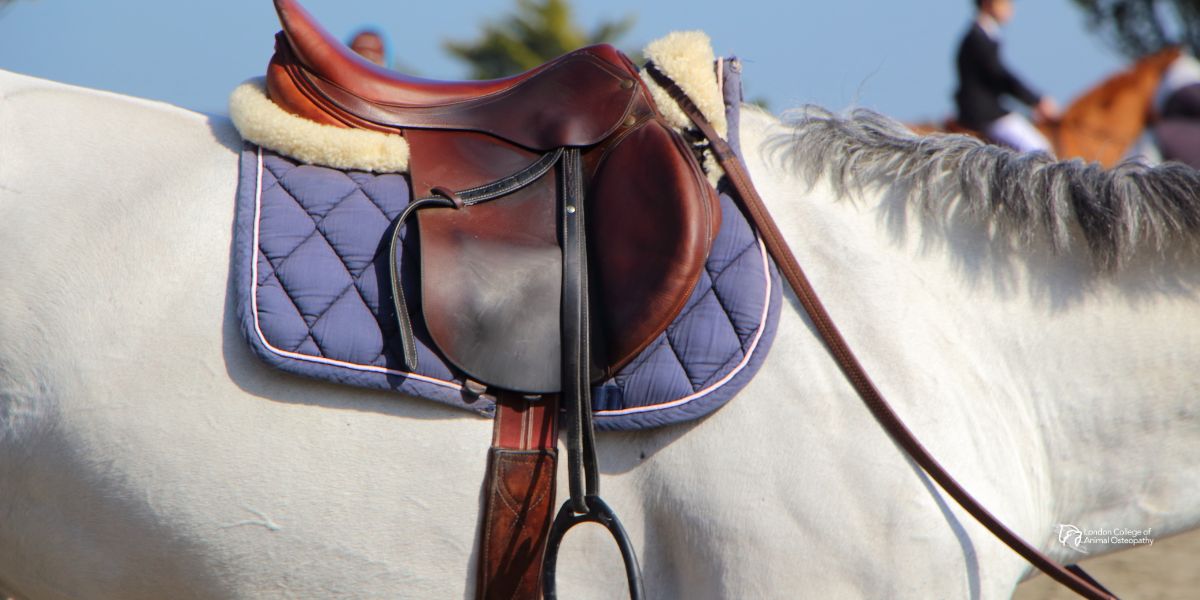
One day, you’re riding in the arena when a good barn mate notices that something seems off about your horse’s movement. Concerned, you dismount and put your mare on the lunge line. You think you may see something too, but you’re not quite sure.
“Notice how your mare doesn’t really reach underneath herself?” your friend asks. “Her hind legs look like they’re trailing out behind her.”
You watch more carefully. Now that she’s pointed it out, you think you can see it, too.
She goes on to point out other things you hadn’t really noticed before: overdevelopment in certain neck muscles, a dip just in front of her withers, some roaching through her lumbar spine, and tight, overdeveloped hamstrings.
As you listen, your mind starts to wander. You think about how jarring your mare’s trot feels and how she struggles to transition into a comfortable canter. You’ve always thought she was simply difficult to sit, or perhaps a little weak behind. Now you begin to wonder if there might be more to it.
As you wrap up with your friend she asks, “When was the last time you had your saddle checked?”
You can’t remember. In fact, your horse came with her saddle when you purchased her three years ago.
On the drive home, you find yourself mulling over your friend’s remarks when you suddenly remember that your mare flinches when you groom her back and she tends to dance around in the crossties when you approach with the saddle. Sometimes, she even pins her ears and raises a hind leg as if warning you away when you put the saddle on.
Maybe your friend has a point.
When Saddle Fit Becomes a Concern
For many riders, the realization that saddle fit may be contributing to changes in a horse’s posture, movement, or behaviour can bring a mixture of concern and uncertainty. It’s understandable to feel anxious about what addressing the problem might involve. There may be time, difficult financial decisions to consider, and if the subject has been raised in a way that feels insensitive or critical, we may naturally become defensive.
Then there are the horses who are simply difficult to fit: mutton withers, prominent or “shark” withers, short backs, aging horses, and horses whose shape and condition change significantly with the seasons or during recovery from an injury. Many of my clients have also shared their dismay after investing in an expensive custom saddle that simply didn’t work out. Even a custom-fitted saddle may not fit properly, particularly as a horse’s shape and condition changes over time.
Taken together, these challenges can make the prospect of finding a saddle that works feel overwhelming before we even begin. So, if the process can seem so complicated, expensive, and uncertain, why start at all?
Why Saddle Fit is Worth Addressing
There are two very good reasons why saddle fit is worth addressing.
First, saddle fit problems are not something we can afford to ignore. The emotional, mental, and physical discomfort a horse experiences can lead to changes in behavior, as well as compensations in posture and movement. Over time, these compensations create imbalance, potentially leading to injury and significant veterinary costs which can be difficult to manage.
And then there is the cost no horse owner ever wants to consider: early retirement, or, most heartbreakingly, the premature loss of our heart horse.
Second, addressing saddle fit doesn’t necessarily mean immediately going out and buying an expensive new saddle. There may be more practical or economical interim options that can improve your horse’s comfort and freedom of movement while you work toward a longer-term solution.
In other words, starting does not have to mean solving everything at once. It means recognizing that something may need attention and finding the most practical way forward for both you and your horse.
Saddle Fit Is Only Part of the Picture
It is also important to remember that saddle fit may be just one piece of a much more complex picture. Underlying health issues, undiagnosed injuries, or conformational differences may influence your horse’s posture and movement, while equine management, riding ability and training practices can also play a significant role. Taking a holistic view helps us avoid assuming that the saddle is always the culprit and instead consider the dynamic relationship between horse, rider, saddle, and the many factors that influence how they move, perform, and behave in general.
Ultimately, assessing saddle fit is the role of an experienced saddle fitter, but that doesn’t mean you can’t educate yourself about the key dimensions of fit and the saddle’s potential impact on your horse. As mentioned earlier, recognizing the signs of poor fit can give you a valuable head start if a saddle fit issue is developing, while also helping you understand when the saddle may not be the whole story.
Understanding the key dimensions of fit can also help you develop an eye for what works and what doesn’t for both you and your horse. The more familiar you become with these principles, the better equipped you’ll be to have an informed conversation with your saddle fitter and make practical decisions about your options.
What Can Be Adjusted?
Once you’ve brought a saddle fitter in, there may be several ways to improve the fit of the saddle you already own. Depending on the saddle’s construction, adjustments may include flocking, changing the gullet plate, or adjusting the tree, if the tree is designed to permit such changes. A saddler may also be able to adjust other aspects of the saddle’s construction, such as revising the seat, panels, billets and blocks on an English saddle, or altering the rigging, blocking the skirt, and re-fleecing the underside of a Western saddle. Of course, the cost of these revisions can vary dramatically depending on what is involved. However, based on the saddle’s value, comfort, and potential to achieve a better fit, investing in these adjustments may be well worth considering.
There may also be opportunities to improve comfort and balance using pads or shims. While these are not permanent solutions, they can sometimes provide meaningful improvement when a horse is developing muscle or gaining weight. In these situations, pads or shims may help accommodate changes in the horse’s shape and, importantly, buy you some time while you work toward a longer-term solution.
It is critical to remember, however, that shimming and padding requires expertise. For example, when a saddle is already too tight, adding padding is like putting on a second pair of wool socks when your boots are already too small. I often see riders adding half pads or extra layers of padding unnecessarily, without realizing that they can further tighten the fit and affect the saddle’s balance.
For a school owner, adopting a policy of best fit can be a practical approach. Often, a saddle that does not work for one horse may work well for another, and boarders may be able to share a saddle for a period of time. Having a variety of saddles on hand also gives riders the opportunity to try several different options and gain valuable experience in recognizing what works for different horses and riders. This same approach can be particularly helpful when searching for a second-hand saddle that fits well and falls within your means, as having the opportunity to trial several saddles increases the likelihood of finding a good fit without exceeding your budget.
Small Changes Can Make a Difference
Other seemingly small changes can make a meaningful difference as well. Switching to a girth or padding that breathes and wicks away sweat, or revisiting your billet or rigging options, may provide some relief and improve overall comfort.
The same can be true of stirrup length. Even a minor adjustment can change the rider’s posture and balance, which can then affect how the saddle applies pressure to the horse’s back. For example, riding with a dressage-length leg in a jumping saddle may work against the saddle’s intended ergonomics, affecting both rider balance and saddle stability.
More broadly, the rider’s posture and balance have a significant influence on how a horse experiences the saddle. In this sense, proper riding instruction can be an important part of the solution, helping the rider develop a more balanced position and become an easier load for the horse to carry.
Even the way we saddle and mount our horse can have an impact. Paying attention to saddle placement, avoiding mounting from the ground, alternating stirrup leathers to prevent uneven stretching, and taking extra care when placing a heavier saddle on the horse are all worthwhile considerations.
When Adjustment Isn’t Enough
That said, it is equally important to understand that some aspects of saddle fit simply cannot be corrected through adjustment. For example, a saddle may not be suited to the rider’s intended activity; the tree may be ill-suited to the shape of the horse’s back; or, if the tree is not adjustable, it may ultimately prevent adequate shoulder clearance. Similarly, spinal clearance may not be achievable, or the saddle may place the rider’s weight too far back onto the lumbar region.
Opinions vary on saddle length, as they do on many other aspects of saddle fit, and the available information can often be conflicting. This is why finding a knowledgeable, client-centred saddle fitter who takes the individual horse and rider into consideration is so vital.

Perfection or progress? When it comes to our horses, progress is often the more meaningful goal.
Perhaps the most important thing to remember about saddle fit is that it is an ongoing process. Horses change with age, conditioning, illness and injury, the seasons, and the day-to-day demands of their care and management. Our own balance, posture, and riding can change as well. While I have touched briefly in this article on the impact we have on the horse through our riding and balance, it is equally important to recognize that rider comfort and welfare matter just as much as the horse’s.
An adjustable saddle can be particularly helpful in accommodating many of these changes, allowing the fit to be modified as the horse’s shape and needs evolve. The rider’s needs may change as well, and an adjustable saddle can help accommodate those changes too. Even so, a saddle that worked beautifully two years ago may no longer be the right choice today. Recognizing that is not an admission that we got it wrong. It is an opportunity to respond to what our horse is telling us now.
Ultimately, a perfect fit may not always be within our reach. What matters is recognizing when something needs attention and finding the best possible fit for the horse and rider within the circumstances we are facing.
That is where progress comes in. Progress may mean making thoughtful adjustments to the saddle you already own, using temporary measures while your horse changes, modifying your riding or your equipment, or eventually finding a different saddle. It means improving comfort, balance, and freedom of movement as much as possible today, while remaining open to further changes tomorrow.
Take Your Saddle Fit Knowledge Further
Are you an equestrian or equine therapist who wants to build real confidence around saddle fit? For therapists, saddle fit is often a gap in existing training, even though it directly shapes the horse's posture, movement, and presenting complaints. For equestrians, it means being able to spot the early signs yourself and have a more informed conversation with your saddle fitter, rather than only reacting once something has clearly gone wrong. Our Saddle Fit Essentials course walks you through the key dimensions of fit, common problem signs, and how to bring that understanding into your clinical work or your own riding.
Head here to Learn more in our Saddle Fit Essentials course.


.jpg)





.png)


.png)
.png)
