
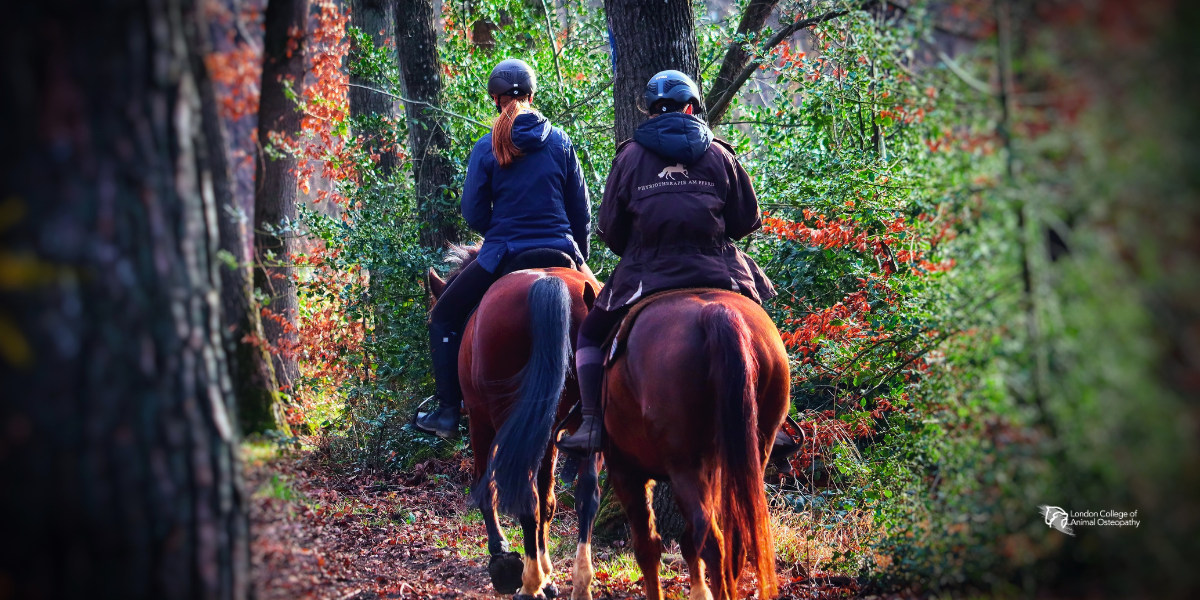
There is a particular sound to a yard on a Saturday morning: boots on concrete, a headcollar clipping onto a tie ring, someone swinging up into the saddle within about ninety seconds of leading their horse out of the stable. Ten minutes later they are picking up a canter. It is not laziness or ignorance. It is simply how riding has always looked for a lot of people, and the horse rarely objects loudly enough to make anyone stop and question it.
What the horse's body is doing in that first stretch of a ride is easy to miss because it is invisible. Muscle temperature is rising. Blood is redistributing toward tissues that were, moments ago, idling. Joints that have been still in a stable overnight are producing and circulating the fluid that lets them move without grinding. None of this happens instantly, and none of it happens if the first thing a horse is asked to do is work at the pace it will be expected to sustain for the rest of the session.
Warming up a horse before riding is not a courtesy extended to sensitive types or older horses. It is a physiological requirement, and the horses who seem to get away without one are usually just not showing the cost yet.
What Ten Minutes Actually Changes in the Body
A cold muscle and a warmed muscle are not the same tissue behaving differently. They have different mechanical properties. Muscle fibres that have not been brought up to working temperature are stiffer, less extensible, and more prone to micro-tearing under load. Warming raises the temperature of the muscle itself, which improves the speed and efficiency of the chemical reactions that produce movement and makes the tissue more pliable under strain.
The same logic applies to the joints. Synovial fluid, the lubricant inside every mobile joint from the fetlock to the poll, is not a static pool sitting inertly in its capsule. It thickens with disuse and thins as the joint moves, a property researchers describe as shear-thinning. A joint that has been immobile overnight in a stable starts a ride with fluid that is thicker and less protective than it will be ten minutes into steady movement. Research into equine joint physiology has shown that immobilisation itself reduces the concentration of the lubricating molecules in synovial fluid, increasing friction between cartilage surfaces until movement restores it.
Why Low Intensity Is the Point, Not a Compromise
A common instinct is to make the warm-up brief because the horse “feels fine” from the first stride. But a scoping review of equine warm-up research found that a low-intensity regimen produced the same beneficial physiological effects, raised heart rate, increased oxygen uptake by the muscles, reduced lactate accumulation, as a higher-intensity one. The point of warm-up was never to test the horse's fitness. It is to give the body time to adapt before it is asked to perform.
Why Osteopaths Notice What Riders Often Miss
Practitioners working with performance and leisure horses spend a lot of time in the first few minutes of a session simply watching a horse walk. That period tells an osteopath a great deal, because a horse cannot mask restriction the way it can mask it once adrenaline and momentum take over at trot and canter. Stiffness through one side of the ribcage, a shortened stride behind, reluctance to stretch the neck forward and down, these are all more visible at the walk than at any faster gait.
This is one of the reasons osteopathic assessment so often begins by asking the rider to describe, in detail, what the first few minutes of a ride usually look like. A horse that consistently feels “sticky” for the opening five minutes and then “comes right” is telling you something real about its tissue quality, not just its temperament.
It's the Rider – Part 1 covers how much of what shows up in a horse's movement originates with the person on top rather than the horse underneath, and warm-up is one of the clearest places this plays out. A rider who mounts and immediately sits heavily, or who picks up contact before the horse has had a chance to lift through its back, can create exactly the kind of asymmetric loading that osteopaths spend their careers untangling later. Warm-up is as much about how a rider asks as it is about how long they wait.
The Difference Between Moving and Warming Up
Leading a horse to the arena and walking a lap before mounting is movement. It is not the same as warm-up, though the two are often confused. A genuine warm-up has a shape to it: a period of loose, unhurried walk on a long rein, followed by a gradual introduction of bend, transitions, and lateral suppling before any collected or demanding work begins.
The walk phase matters more than most riders give it credit for. It is during unhurried walking, not trotting, that a horse is most able to stretch through the topline and allow the spine to move through its full available range without the added complexity of impulsion. Rushing this phase to “get to the good bit” removes the one part of the session where the horse's body has the best chance to prepare itself without compensating.
Reading the Signs That Warm-Up Is Working
A horse that is warming up well tends to soften visibly. The walk lengthens, the poll drops slightly, the back lifts almost imperceptibly under the saddle. A horse that is not warming up well often does the opposite: it shortens its stride further as work increases, hollows away from contact, or feels no different at minute fifteen than it did at minute two. That last pattern in particular is worth paying attention to, because it usually means something structural rather than simply a slow starter.
When the Warm-Up Reveals a Problem
Sometimes what a warm-up uncovers is not a training issue at all. A horse that consistently resists rounding through the back during the early minutes of a ride, particularly one that also shows sensitivity when the saddle area is palpated, may be dealing with a genuine restriction rather than stiffness that will simply work itself out. Kissing Spines in the Equine Patient describes how subtle changes through the thoracolumbar region often show up first as a reluctance to warm up normally, long before more obvious signs of pain appear.
This is worth sitting with, because the instinct when a horse feels awkward early in a ride is often to push through it, on the assumption that more movement will resolve stiffness that movement caused in the first place. Sometimes that assumption holds. Sometimes it does not, and the horse that “always takes a while to loosen up” has been quietly compensating for months.
Building a Warm-Up That Actually Works
There is no single correct warm-up template, because the right one depends on the horse's age, discipline, fitness, and whatever history is already in the file. What holds across all of them is the underlying sequence: unhurried walk first, without contact or demand, followed by a gradual build through trot with plenty of straight lines and gentle changes of direction before any lateral work or collection is introduced. Canter, where it is used at all in warm-up, comes only once the horse is moving freely and evenly at the slower gaits.
Weather changes this timeline. A horse warming up in cold conditions needs longer at the walk than one working in a mild indoor school, because cold tissue takes longer to reach working temperature and cold joints take longer to circulate fluid effectively. Older horses and those managing arthritis need the same principle applied more generously rather than differently in kind. Their tissues are not broken, they simply need more time to do the same job.
What This Looks Like for Horses With a History of Back Pain
Horses recovering from or managing back-related conditions are often the ones for whom warm-up matters most and gets rushed most. There can be a temptation to keep sessions short overall by cutting the preparatory phase, on the logic that less total work means less risk. In practice this often achieves the opposite, asking a compromised back to bear a rider's weight before it has had any chance to prepare for it.
A Final Thought
Ten minutes rarely feels like much when weighed against an hour-long ride, and it is easy to see why it gets compressed on a busy morning. But that opening stretch is doing work that cannot be recovered later in the session. A horse that starts moving properly starts loading its joints, tendons, and back correctly from the first stride, rather than catching up to correct movement somewhere in the middle. Riders who protect those first ten minutes tend to end up, over years rather than weeks, with horses whose bodies have simply had fewer reasons to go wrong.
Frippiat, T., & Votion, D.-M. (2024). Warm-Up Strategies and Effects on Performance in Racing Horses and Sport Horses Competing in Olympic Disciplines. Animals, 14(6), 945.
Watkins, A., Fasanello, D., Stefanovski, D., et al. (2021). Investigation of synovial fluid lubricants and inflammatory cytokines in the horse. BMC Veterinary Research.
MacKechnie-Guire, R., & Pfau, T. (2021). Differential Rotational Movement of the Thoracolumbosacral Spine in High-Level Dressage Horses Ridden in a Straight Line, in Sitting Trot and Seated Canter Compared to In-Hand Trot. Animals, 11(3), 888.


.jpg)





.png)


.png)
.png)
